
Thinking about Money
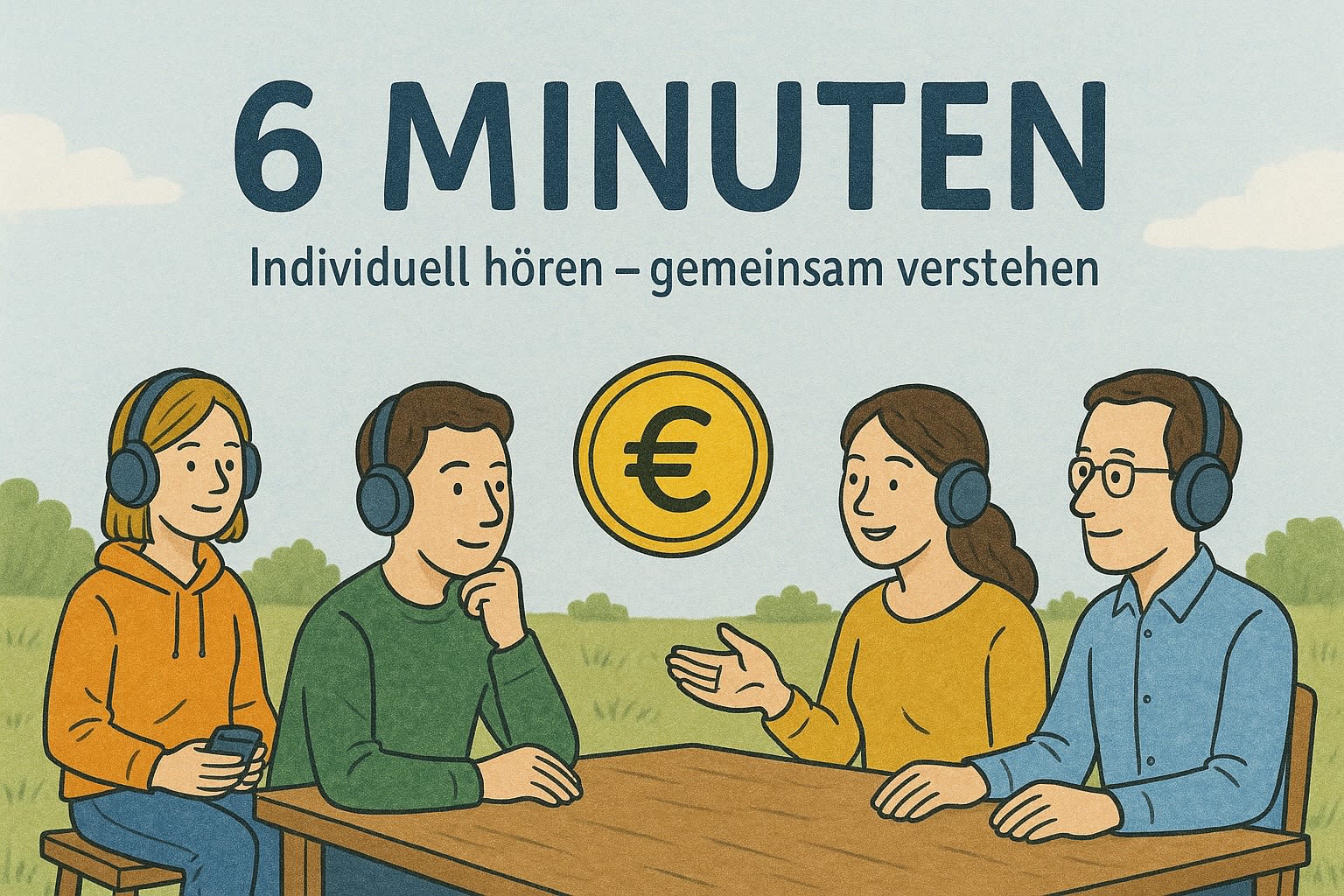

The short audio format of around six minutes serves as an impetus for joint learning and thinking. Each participant first listens to the contribution individually. This creates space for their own thoughts, questions, and associations—an important prerequisite for deeper understanding.
These individual impressions are then brought together in a group discussion. Questions, objections, and new perspectives are shared and discussed. Passive listening thus becomes an active learning process in which insights are developed jointly and knowledge is networked.
- Didactic advantage:
- Short, concentrated recording promotes attention and understanding.
- Individual reception enables personal approaches to the topic.
- Joint discussion anchors knowledge in the long term and trains critical thinking.
This combination of individual initiative and collective reflection strengthens both factual knowledge and the ability to reflect independently on complex economic issues.
The Money Case
The film "The Case for Money" examines money as the hidden culprit behind social crises such as war, inequality, and climate change. Money is not a neutral tool, but a pure medium of exchange with no intrinsic value, whose power arises from collective dependence. It has a built-in logic of growth: in order to survive, the system must constantly expand, which is generated by lending. Money emerged in the 16th century alongside the modern state and private property, which act as accomplices, as the state enforces the rules and private property guarantees exclusivity. Capitalism is just the cover name—money itself is the real engine of this system and its problems.
The great money myth
The Great Money Myth debunks the classic narrative that money originated from bartering as a myth. Historically, early forms of money were not about trade, but about settling social and moral debts, e.g., peacemaking or strengthening communities. It was only the "great reversal" in the 16th century that forced people to participate in the market—money became a condition for survival. This created a system that profoundly shapes our way of thinking: the logic of money drives efficiency, competition, and capital formation, making alternatives seem almost unimaginable.
The invention of money
"The Invention of Money" shows that the widely accepted school history of the origin of money through barter is a myth. Historically, money was initially used to settle large social debts, such as atonement or relations between clans, not for trade. Over centuries, money transformed from physical objects to an abstract, digital quantity. Today's economic systems are based on the compulsion for constant growth, whereby money becomes an end in itself. This logic shapes not only markets, but also our thinking. The monetary system is a man-made technology – and therefore, in principle, changeable.
The growth machine
The video explains that money has an inherent "compulsion to grow": it wants and needs to multiply, regardless of people's wishes. Money is therefore not neutral, but inherently designed to generate profit and act as capital. As soon as the growth of money ends, the entire system enters a crisis. This view comes from Eske Bockelmann and states that every society with money is inevitably capitalist. The crucial question remains: What happens when the pursuit of eternal growth collides with the limited resources of our planet?
 Built with Shorthand